Author: Chip Bennett

  • Catching Up: Lillian’s Birth and First Days

    UPDATE: To see the complete photo sets: Lillian’s Birth, Lillian – Newborn. Also, all of Lily’s pictures are in the Lillian Collection.

    So far, things are going well. Lily has just been fed, and Stephanie is taking a nap, so I will try to take this opportunity to catch everyone up on things so far.

    Stephanie started showing signs of imminent labor Wednesday, so I decided to go ahead and start my vacation Thursday. That afternoon at her OB appointment, her doctor told her that she was already 3 cm dilated. We scheduled an induction for Monday, but her doctor said that he was 80% sure that she would go into labor on her own before then.

    Friday morning, I woke up early (about 5:15 am). After breakfast and coffee, I made a quick trip to the store for some last-minute necessities, and another quick stop at the grocery store to have some food available for Steph’s sister Angie, who was on her way for a surprise, early visit.

    As I was finishing the the dishes in the kitchen before making lunch around 1:00 in the afternoon, Stephanie came out of the bedroom and said, “Are you ready to have this baby?” She then told me that her water had broken! We called her doctor, who told us to go ahead on in to the hospital. We made our last-minute preparations (toiletries, pillow, etc. – most of everything we needed was already packed in the car), made the requisite phone calls to family, and headed – finally! – the the hospital.

    Stephanie was checked in and situated in her LDR a little before 3:00 pm. When the nurse checked her, she was 3-4 cm dilated. She progressed through labor throughout the afternoon and evening as various family members arrived at the hospital, until she reached 8 cm and 100% effaced at around 9:00 pm.

    Unfortunately, her dilation stopped progressing at this point, and Stephanie began developing a low-grade fever. At 6 cm of dilation, the nurse had told us that the baby was already showing signs of developing a cone head – a sign that she might have problems getting through the birth canal. After a couple hours at 8 cm, the nurse told us that her cervix was beginning to swell – a further sign of potential difficultly with labor. After five hours of no further dilation from 8 cm, and a fever that continued to creep up, at 2:00 am we made the decision to deliver via c-section.

    Surgery prep went by quickly, and I almost forgot to grab my camera and baby book(s) from the LDR. After gowning up and waiting for the surgery team to get prepared, I was invited into the OR for the procedure. Before it even seemed to have begun, I heard our doctor announce, “here she comes!” and I looked over the sheet just in time to see our beautiful baby girl out of the womb for the first time!

    Her nurses quickly began cleaning her up, and determined her 1- and 5-minute APGAR scores (8 and 9).


    Lillian_birth 010

    Lillian_birth 013

    Lily’s first cleanup and APGAR
    Photo © Chip Bennett, all rights reserved.

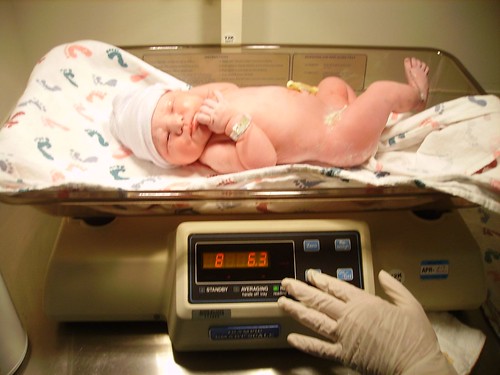
    The doctor began cleaning/stitching up Stephanie’s incision, and commented on how fit she looked internally, and how good her tissue was – hopefully a sign that her incision will heal well. In the meantime, the nurse and I took Lily over to the scale for her official first weigh-in. Our little girl tipped the scales at a healthy 8 lbs, 6 oz:
    Lillian_birth 021

    Lillian’s official first weigh-in
    Photo © Chip Bennett, all rights reserved.

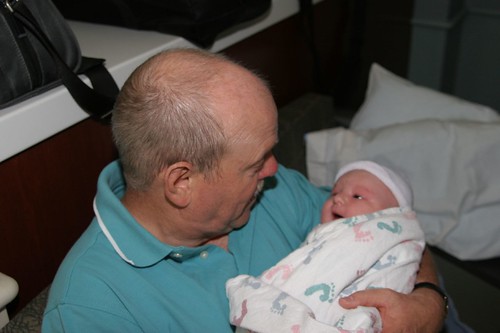
    Once the doctor was finished taking care of Stephanie, we were moved to the OB recovery room at 3:00 am for two hours of recovery. Since Steph was still recovering, I got to spend a lot of quality time holding our little blessing. Even only hours old, Lily was quite active and attentive. Even though her little eyes couldn’t yet focus, it was amazing to see her recognize and respond to the sound of my voice:

    Lillian_birth 025

    Lillian swaddled, spending quality time with daddy
    Photo © Chip Bennett, all rights reserved.

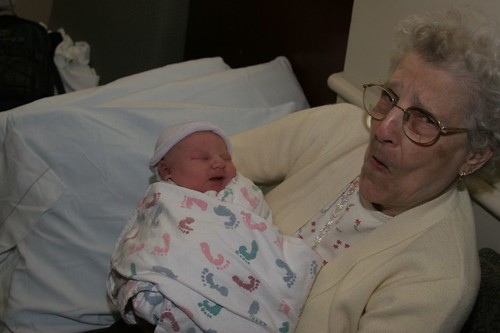
    Nana Bennett, Gee-Gee, and Aunt Angie got to come see Steph and Lily in the OB recovery room:

    Lillian_birth 035

    Lillian_birth 038

    Lillian with Nana Bennett and Aunt Angie
    Photo © Chip Bennett, all rights reserved.

    Finally, at 5:00 am, Stephanie was taken up to her postpartum room. Lillian went to the nursery for additional check-ups, and Steph and I were able to get about an hour of sleep. At 6:00 am, Lillian was brought in for her first attempt at feeding. To our great pleasure, she latched on at her first try, and has been nursing like a champ ever since!

    After nursing, mommy, daddy, and baby all slept for a couple of hours. Lily had another feeding around 9:00, while I went down to the cafeteria to have breakfast with Lily’s Nana, Papaw, and Gee-Gee. Afterward, Lily got to spend a few minutes with everyone before they headed back to Indianapolis.

    Lillian_birth 041

    Lillian_birth 044

    Lillian_birth 048

    Lillian_birth 052

    Lillian with Gee-Gee, Nana Bennett, Papaw Bennett, and one of our first family photos
    Photo © Chip Bennett, all rights reserved.

    The rest of Saturday was spent sleeping and feeding. I had my first of what are sure to be many milestones: I changed my first diaper ever, and I was peed on while changing a diaper for the first time ever. My swaddling skills improved with each diaper change and breast-feeding. Lily seemed to be getting plenty of colostrum, as she continued to nurse well, and kept leaving her daddy plenty of presents in the form of dirty and wet diapers!

    After being up for more than 24 hours straight the day before, and not getting much sleep while trying to help Steph as much as possible during the day Saturday, I finally crashed Saturday evening. I slept a couple hours between the 7:00 pm and 10:00 pm feedings, but by 11:00 pm I was out for good, and didn’t wake up until 7:00 am Sunday.

    After breakfast, Steph finally got the chance to sleep uninterrupted for 2-3 hours, most of which time I spent with Lily sleeping on my chest while I watched tv or just sat enjoying having our little angel sleeping so contentedly against me.

    Sunday was Mother’s Day, and an obviously special one for us! Stephanie got a little gift from the hospital, and although I was unable to get her the flowers that I wanted to before she went into labor, I was able to find a nice bouquet in the hospital gift shop:

    Mother's Day

    Stephanie’s Mother’s Day bouquet
    Photo © Chip Bennett, all rights reserved.

    Most of Sunday was spent continuing to develop our routine with Lily: changing diapers, nursing, burping, sleeping, etc. Stephanie also progressed from an ice-only diet first to clear liquids, and then finally to solid foods. She continued her physical recovery, and was able to stand up to use the restroom and was even able to take a shower in the evening.

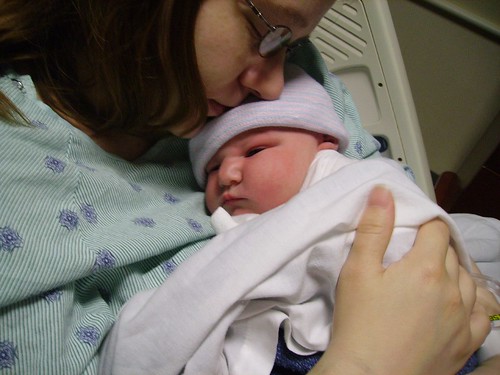
    Sunday evening saw the three of us sharing some quiet time together. After nursing, Lily finally got the chance to snuggle with mommy, since Steph had recovered well enough to hold Lily a bit on her chest. Baby and mommy got to spend some much-needed quality time together:

    Lillian Newborn 016

    Lillian Newborn 017

    Lily and mommy having some quality time together
    Photo © Chip Bennett, all rights reserved.

    Today finds us with more of the same: Lily had an early-morning feeding, and Steph and I had breakfast while Lily had another check-up in the nursery. After another feeding, Steph is getting some more very-much needed sleep. Later today Steph is going to try out the breast pump (she thinks her milk may be coming in), and if she is feeling up to it, we are going to go down to the courtyard early this evening to spend some time outside.

    The normal hospital stay for a c-section recovery is four bed-nights, which means that we can be here until Wednesday morning; however, if all continues to go as well as it has been, we are planning to head home tomorrow morning. We are looking forward to getting settled in at home!

    I will do my best to keep everyone updated!

  • OYB May 13

    Today´s reading:
    OT: I Samuel 14
    NT: John 7:31-53
    Ps: Psalm 109
    Pr: Proverbs 15:5-7

    Happy Mother’s Day, everyone!

    Photo of the Day:

    Lillian_birth 052

    Our first family photo!
    Photo © Chip Bennett; all rights reserved

    The One Year Bible Blog´s comments for today.

  • Happy Mother’s Day!

    And here’s why it is especially happy for us today:

    Lillian_birth 053

    One of our first family photos! (Lillian’s birth photo set)
    Photo © Chip Bennett, all rights reserved.

    Lillian_birth 052

    One of our first family photos! (Lillian’s birth photo set)
    Photo © Chip Bennett, all rights reserved.

  • OYB May 12

    Today´s reading:
    OT: I Samuel 12-13
    NT: John 7:1-30
    Ps: Psalm 108
    Pr: Proverbs 15:4

    Gospel Thread – OT, NT, Psalms/Proverbs:

    I apologize if this is a cop-out, but my mind is elsewhere today. Rather than try to manufacture something to put here today, I am just going to say that I have nothing to add today, because my mind is on my daughter.

    The One Year Bible Blog´s comments for today.

  • Lillian is Born!

    I will write up a more complete description once I’ve had some sleep, but just to give you the overview: Lillian Nicole Bennett was born at 2:27 AM on May 12, 2007, via c-section. She weighed in at 8 lbs 6 oz, and her APGAR scores were 8 and 9. Baby and mom are doing well, if exhausted.

    Lillian_birth 025

    Lillian’s Birth Photo Set
    Photo © Chip Bennett, all rights reserved.

  • Labor Has Started!

    Yesterday afternoon Stephanie had her final OB appointment, at which time we found out that she was dilated to 3 cm. We scheduled an induction for Monday, but the OB gave her an 80% chance of going into labor before then.

    Stephanie woke up around 1:00 this afternoon to discover that her water had broken. We called the doctor, and he sent us straight to the hospital. She was dilated 3-4 cm at the time of admission, and just had her epidural.

    I don’t plan to “live blog” the labor and delivery, but for those of you with my IM contacts, check my away messages for updates.

    I’ll be back later, with pictures of our newborn Lily!

  • OYB May 11

    Today´s reading:
    OT: I Samuel 10-11
    NT: John 6:43-71
    Ps: Psalm 107
    Pr: Proverbs 15:1-3

    Gospel Thread – OT:

    No direct gospel reference in today’s OT reading.

    Gospel Thread – NT:

    I am the bread of life.

    John 6:48 (NIV)

    This sometimes-difficult passage is summed up in these six words. Jesus explains the spiritual and symbolic meaning of this passage at the last supper, when He institutes the sacrament of communion: the bread and wine symbolize Jesus’ body and blood – the body broken to bear the wrath that was due for man’s sin, and the blood that was shed as the sacrifice for sin.

    Gospel Thread – Psalms/Proverbs:

    1 Give thanks to the LORD, for he is good; his love endures forever.
    2 Let the redeemed of the LORD say this—those he redeemed from the hand of the foe

    Psalm 107:1-2 (NIV)

    Indeed, God has redeemed us from the hand of our foe: both from sin and from Satan himself. Our response to this truth should be one of eternal thankfulness and gratitude. May we always set our thoughts on the eternal love of our Lord, and respond in kind with our own love and gratitude.

    The One Year Bible Blog´s comments for today.

  • Greek Study Falsely Disparages Low-Carb/High-Protein Diets – Part 1

    For background information, see the Introduction.

    Part 1: Is It Really Low-Carb?

    The study purports to evaluate “the effects on mortality of habitual low carbohydrate–high-protein diets that are thought to contribute to weight control.” – ostensibly, this study evaluates low-carbohydrate/high-protein diets designed for weight control (that is, weight loss). In other words, this study purports to evaluate low-carb weight-loss diets. (I may sound repetitive here, but I have a purpose). What, then, does this study consider to be “low-carbohydrate/high-protein”?

    According to the Results section:

    With respect to the choice LC/HP score that relies on energy-adjusted components, at the high extreme of the distribution around 20% of energy intake was derived from proteins, whereas around 25% was derived from carbohydrates. At the low extreme of the distribution, around 10% of energy intake was derived from protein, whereas more than 50% was derived from carbohydrates.

    Thus, for the purposes of this study, “low-carbohydrate/high-protein” means 25% carbohydrate and 20% protein.

    Yes, you read that right: this study claims that a diet that includes 25% of its caloric intake from carbohydrate is “low-carb”, and that a diet that includes 20% of its caloric intake from protein is “high-protein”.

    For a 2,000 kCal daily intake, these values equate to 500 kCal, or 125g, of carbohydrate per day – and bear in mind, this is the most extreme low-carb limit in the study. (Likewise, these values equate to 400 kCal, or 100g, of protein per day, for a 2,000 kCal daily intake. This is the extreme high-carb limit in the study.)

    So, my first question is this: what mainstream low-carb diet in any way resembles this macro-nutrient intake?

    To put the bounds of the study into perspective, here are the mean macro-nutrient intake values for the population:

    In this population, the mean intake of protein was 76 g/day with standard error of the mean (s.e.m.) 0.16 g/day, the mean intake of carbohydrates was 208 g/day with s.e.m. 0.44 g/day, and the mean intake of lipids was 109 g/day (28% saturated, 15% polyunsaturated, 48% monounsaturated fatty acids and 9% other components of the lipid group) with s.e.m. 0.25 g/day.

    Let’s explore those numbers for carbohydrate intake: mean intake 208 g/day, s.e.m. 0.44 g/day. Standard Error on the Mean (s.e.m.) is equal to the standard deviation (σ) divided by the square root of the number of samples (total population size). The total population size is 22,944; the square root of 22,944 is 151.5. Thus:

    s.e.m. = 0.44 g/day = σ / 151.5

    σ = 0.44 g/day * 151.5 = 66.7 g/day

    Thus, carbohydrate intake for the study was a mean of 208 g/day with a standard deviation of 66.7 g/day.

    Standard Deviation is the measure of the distribution around the mean. We can probably safely assume that our population is normally distributed (bell-shaped curve, with the peak at the mean, and exactly half of the population on either side of the peak). In a normally distributed set of data, 2/3 of all data lie within 1 σ of the mean, and 90% of all data lie within 2 σ of the mean.

    Therefore, given the values for mean and standard deviation, we know that, statistically speaking, 2/3 of the study participants had a carbohydrate intake between 141 and 274 g/day, and that 90% of the study had a carbohydrate intake between 75 and 340 g/day.

    How accurate is that estimate? The accuracy depends on the normality of the distribution.

    According to Table 1 of the study, only 552 men (5.9%) and 2,218 women (16.3%) – a total of 2,770 participants (12.1%) had a carbohydrate intake of less than 140 g/day.

    Based on the mean and standard deviation above, we can estimate that since 2/3 of the study participants had a carbohydrate intake between 141 and 274 g/day, that 1/3 were outside of that span – half of which (1/6, or 16.7%) had a carbohydrate intake of less than 140 g/day.

    If anything, the distribution is biased against the low-carb side of the curve – meaning that the true number of participants at any given standard deviation is actually less than predicted by the normal curve.

    The two most popular mainstream low-carb diets are the Atkins Diet and Protein Power (the South Beach diet does not consider itself to be “low-carb” and is excluded here).

    The Atkins Diet allows anywhere from 20g carbohydrate per day in the Induction phase to 60-90g carbohydrate per day in the Maintenance phase (with allowance for more than 90g per day for active exercisers).

    Protein Power allows anywhere from 40g carbohydrate per day at the Intervention level to 80g carbohydrate per day at the Maintenance level (according to Table 13.6 of my Protein Power Lifeplan book, page 355).

    That means that less than 5% of the study participants had a carbohydrate intake anywhere near what is specified by mainstream low-carbohydrate diets.

    In other words, this study in no way resembles either mainstream, low-carbohydrate diet. Therefore, any conclusions to which this study might lead do not apply to mainstream low-carbohydrate diets.

    Coming Soon – Part 2: Is It Really High-Protein?

  • Greek Study Falsely Disparages Low-Carb/High-Protein Diets – Introduction

    Introduction

    Recently, Jimmy Moore at Livin’ La Vida Low-Carb linked to an epidemiological Greek Study that purported to compare mortality rates of Low-Carb/High-Protein and High-Carb/Low-Protein diets, along with a challenge from Dr. Steven Acocella – a vocal critic of low-carb diets – to refute it under the assumption that it is a legitimate study:

    I will not editorialize on the study, but simply listen to you and your reader’s comments. I will say that there’s no reason that we need to dispute the efficacy of the study itself. Let’s go from the position that the study is not flawed. Let’s discuss the science and findings.

    The conclusions of the authors are reproducible and consistent. What do you all think? If you do post this study I applaud your willingness to explore the science and not ignore nor dismiss it.

    Many of Jimmy’s readers have been up to the challenge, and I would like to throw in my two-cents’ worth.

    First, let’s examine the abstract, to get a basic understanding of the study. Here is the study objective:

    We have evaluated the effects on mortality of habitual low carbohydrate–high-protein diets that are thought to contribute to weight control.

    As the objective states, the object of the study was to evaluate the effect on mortality rate of so-called low-carbohydrate/high-protein diets – ostensibly, low-carbohydrate weight-loss diets.

    The study setting is the general Greek population. Here are the subject methods:

    Follow-up was performed from 1993 to 2003 in the context of the Greek component of the European Prospective Investigation into Cancer and nutrition. Participants were 22 944 healthy adults, whose diet was assessed through a validated questionnaire. Participants were distributed by increasing deciles according to protein intake or carbohydrate intake, as well as by an additive score generated by increasing decile intake of protein and decreasing decile intake of carbohydrates. Proportional hazards regression was used to assess the relation between high protein, high carbohydrate and the low carbohydrate–high protein score on the one hand and mortality on the other.

    In other words, this is an epidemiological study based on the Greek-population subset (about 23,000 people) of the EPIC study from 1992 to 2003. Analysis is based on separating this subset into various decile groups based on descending protein intake, ascending carbohydrate intake, and a sum of the two deciles.

    Understanding these groupings is key to understanding the study, so let’s take some time with the explanation. For the three analysis groups, participants were separated into decile groups – that is, groups of 1/10 of the total – based on the given criterion. So, for the descending protein intake group, all 23,000 participants are ordered based on protein intake, and the highest 2,300 participants are placed in the first decile (and so on, for all 23,000 participants). Likewise for descending carbohydrate intake (except, in this case, the 2,300 lowest carbohydrate-intake participants are placed in the first decile). Finally, for the third analysis group, each participant’s two decile “scores” (the first decile is scored a “1” and the tenth decile is scored a “10”) are added together, and groups are defined from a “score” of 2 (low-carb/high-protein) to 20 (high-carb/low-protein). Make sense?

    Moving on: The study claims the following results:

    During 113 230 persons years of follow-up, there were 455 deaths. In models with energy adjustment, higher intake of carbohydrates was associated with significant reduction of total mortality, whereas higher intake of protein was associated with nonsignificant increase of total mortality (per decile, mortality ratios 0.94 with 95% CI 0.89 –0.99, and 1.02 with 95% CI 0.98 –1.07 respectively). Even more predictive of higher mortality were high values of the additive low carbohydrate–high protein score (per 5 units, mortality ratio 1.22 with 95% CI 1.09 –to 1.36). Positive associations of this score were noted with respect to both cardiovascular and cancer mortality.

    Finally, the study makes the following conclusion:

    Prolonged consumption of diets low in carbohydrates and high in protein is associated with an increase in total mortality.

    Sounds pretty bad for low-carb diets, eh? Perhaps – or perhaps not. We need to dig deeper into the study in order to decide.

    Read on, in Part 1: Is It Really Low-Carb?

  • Brother-In-Law Highlighted as Military Hero

    Michael Shropshire

    Congratulations to my brother-in-law, Michael Shropshire, for being highlighted as one of the Department of Defense’s Heroes in the War on Terror!

    Michael was awarded the Silver Star for his efforts in the battle for the Euphrates River bridge at Najaf with the famed 7th Cavalry (3rd Division, 7th Cavalry – of General Custer fame), the “tip of the sword” for much of the military advance from Kuwait to Baghdad in Operation Iraqi Freedom. This 36-hour battle (press coverage here, here, here, here, here, here) was among the most fierce the military faced. (See pages 17-19 of this PDF for a detailed description of the Najaf operation.)

    The silver star is the third-highest military honor:

    The Silver Star is awarded to a person who, while serving in any capacity with the U.S. Army, is cited for gallantry in action against an enemy of the United States while engaged in military operations involving conflict with an opposing foreign force, or while serving with friendly foreign forces engaged in armed conflict against an opposing armed force in which the United States is not a belligerent party. The required gallantry, while of a lesser degree than that required for the Distinguished Service Cross, must nevertheless have been performed with marked distinction.

    Michael’s gallantry is described in this Fort Drum coverage of the Silver Star award ceremony:

    Shropshire was honored for his contribution to Operation Iraqi Freedom at Abu Sukhayr, Iraq, in March 2003 when the Army unit he was attached to was attacked and surrounded by enemy forces. Surrounded, cut off, under a hail of enemy gunfire and in the largest sandstorm in four decades, Shropshire coordinated close air support while constantly switching from the radio handset to his rifle.

    The sandstorm cut the controller visibility dramatically, and it was compounded by rain. “It was basically raining mud,” he said. Because of this fact, he heavily relied on outside technology like the Joint Surveillance Target Attack Radar System, which helped him to “see” through the muck.

    The sergeant then left the security of his armored vehicle to confirm enemy armor locations. Low on ammunition, in a blinding sandstorm and under intense enemy fire, the sergeant directed the munitions that destroyed 10 T-72 tanks. This act dismounted enemy forces about to overrun the unit’s position. He then quickly repaired his bullet-ridden satellite antenna and coordinated other air strikes.

    “I couldn’t have done this by myself,” he said. “There were a lot of people on the outside working their pieces to help me accomplish my mission. The joint team worked out really well.”

    Tactical air controllers are Air Force specialists who are assigned to Army combat maneuver units around the world. They are typically a two-airmen team that works in an Army ground unit to direct close air support toward enemy targets on the ground. Airmen of the 18th ASOG operate and are deployed from 18 different locations across the United States.

    (See also here and here.)

    Michael’s job entails quite a bit of advanced technology. See the description of the battle from this piece on network centricity, which explains that Michael was credited with the destruction of over 60 tanks and armored vehicles and hundreds of trucks:

    Recent combat experience provides a host of real-world examples of the power of network-enabled operations. The example I like best is that of U.S.A.F. Staff Sergeant Michael Shropshire, an Air Force Enlisted Terminal Attack Controller who in 2003 fought his way through northern Iraq with the troops of the 7th Cavalry during Operation Iraqi Freedom. The 7th Cavalry was the unit that got massacred at Little Big Horn under General George Custer over a century ago.

    Outside Najaf, Shropshire’s unit became engulfed in a ferocious sandstorm. Tasked with securing a strategic bridge, the unit was isolated and surrounded on all sides by heavy Iraqi forces. Shropshire’s satellite radio became the primary form of communication for the endangered troops since the ground-force FM radios suffered from limited range.

    Using the space-based link to the network, Shropshire was alerted by an Air Force JSTARS surveillance aircraft—one of just a handful of assets in the world that can peer through sandstorm conditions—that 10 T-72 tanks were about to overrun his unit. After receiving this information, Sergeant Shropshire left his armored personnel carrier and coolly directed a B-1 bomber to drop 12 GPS-guided JDAMs directly on the enemy tanks. He also quickly coordinated with inbound fighters to destroy an armored formation attacking from the other direction. Altogether, Sergeant Shropshire orchestrated the destruction of over 60 tanks and armored vehicles and hundreds of trucks.

    Because of network-centric capabilities, this two-legged knowledge-enabled war fighter was able to gather a worldwide network of sensors, shooters, and space systems in support of a single, isolated cavalry troop—through sand and rain and directly on target. A lot of troopers in the 7th Cavalry owe their lives to Sergeant Shropshire, who helped to prevent another Little Big Horn for the fabled regiment and came home with a Silver Star.

    Shropshire was a network-enabled fighter. But just a decade ago his position would have been much different. How would he have received information? How current would that information have been? How would the data have come to him? The pace of change has accelerated rapidly in recent years. For example, my company currently had a Global Hawk unmanned intelligence, surveillance, and reconnaissance aircraft flying in theater equipped with the Advanced Information Architecture—the low cost of electronic storage allowed us to put a computer on the aircraft that stores huge quantities of information. With this aircraft in the region, the individual soldier can use his Personal Digital Assistant to pull down up-to-date information on his location and the surrounding area within a few minutes.

    Congratulations, Michael!